
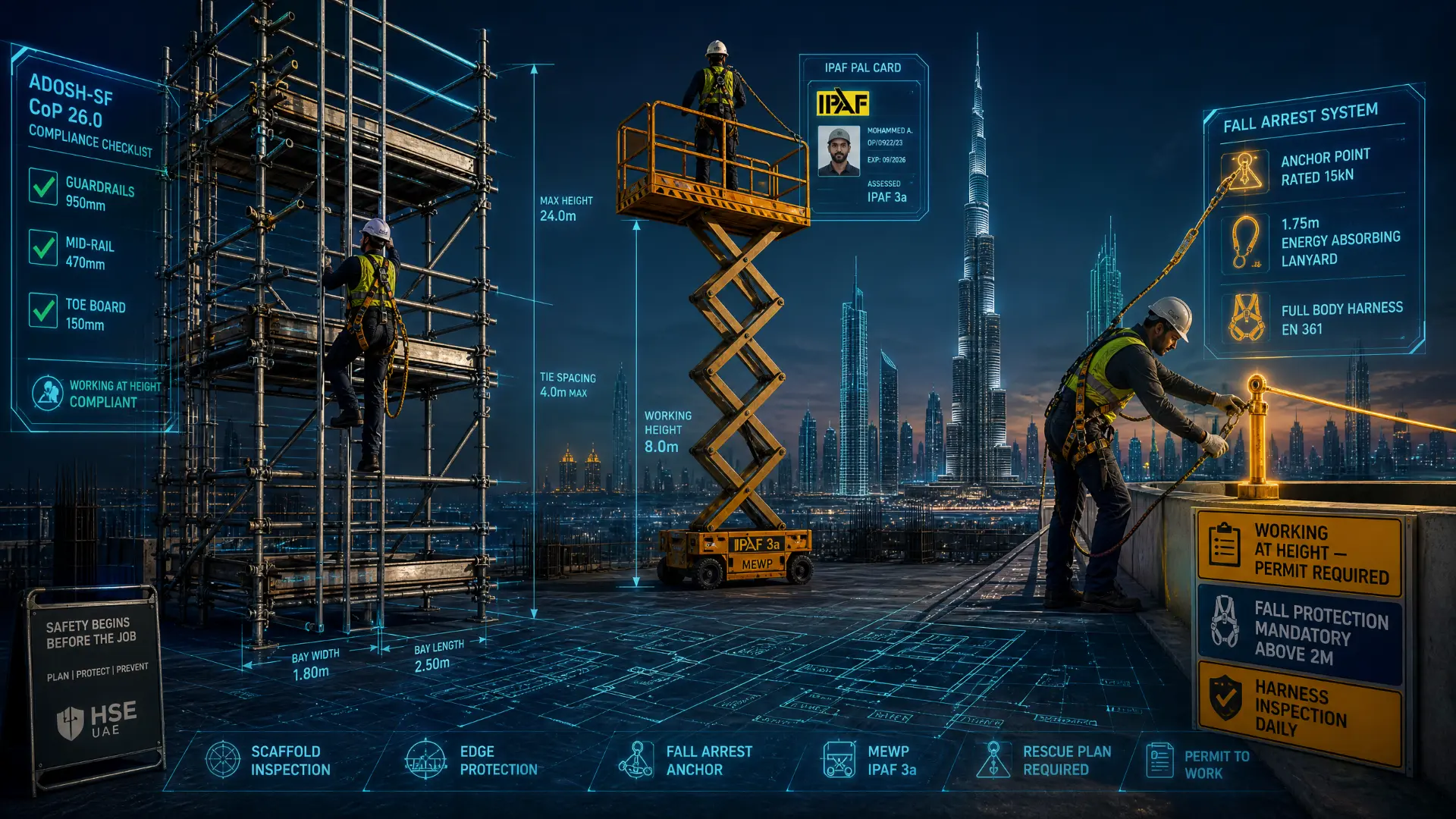
UAE Working at Height
Scaffolding, ladders, edge protection and fall arrest systems under ADOSH-SF CoP 23.0, CoP 26.0 (Scaffolding) and CoP 37.0 (Ladders), plus the Dubai Municipality Code of Construction Safety Practice, MEWPs and suspended access, fragile roofs, and the rescue plan that makes a permit valid. Falls from height are the third most common compliance gap on UAE sites, after temporary electrical installations and plant.
- 8
- Compliance areas
- 11
- Authority profiles
- 115
- Checklist items
- 105
- Critical items
Compliance areas
How ADOSH-SF CoP 23.0 and Dubai Municipality expect work at height to be avoided, prevented and then mitigated — including the 1.8 m trigger height, risk assessment, permits and competent-person duties.
Design, erection, scafftag inspection regimes, tube-and-fitting and system scaffolds, mobile towers, loading limits and ties — to ADOSH-SF CoP 26.0, DM Code of Construction Safety Practice, BS EN 12811 and BS 5975.
When a ladder is acceptable at all under ADOSH-SF CoP 37.0, BS EN 131 professional classification, the 1:4 rule, securing and footing, pre-use checks and the colour-code register expected by UAE inspectors.
Guardrail geometry and strength, slab-edge systems, stair and lift-shaft protection, floor-opening covers, hole marking and barricade discipline under ADOSH-SF CoP 23.0 and the DM Code.
Harnesses, lanyards, self-retracting lifelines, anchor points and horizontal lifelines — clearance calculations, 6-monthly thorough examination, LOLER-style records and the UAE competence expectations.
Scissor lifts, boom lifts, mast climbers, suspended cradles/BMUs and rope access — operator licensing, third-party certification, harness rules, rescue and UAE-specific permit requirements.
Roof access control, fragile materials such as rooflights and cement sheeting, crawling boards, perimeter protection and the heat-related constraints specific to UAE roof work.
Suspension trauma, the 15-minute rescue window, rescue equipment and drills, and the emergency information UAE authorities expect in a work-at-height permit.
Who regulates what
Abu Dhabi Occupational Safety and Health Centre (ADOSH-SF, formerly OSHAD)
CoP 23.0 is the primary work-at-height code for Abu Dhabi emirate, applied through the sector regulatory authority (usually DMT for construction). Entities must show a documented hierarchy of control, competent persons, inspection regimes and a rescue capability.
Dubai Municipality — Building Permits & Construction Safety
Dubai Municipality enforces the Code of Construction Safety Practice on all sites within the municipality boundary, requiring scaffold inspection regimes, edge protection, permits for high-risk height work and competent supervision. Non-compliance carries administrative fines and stop-work notices.
Trakhees — Ports, Customs & Free Zone Corporation, EHS Department
Applies in Palm Jumeirah, Dubai Maritime City, Jebel Ali and other PCFC jurisdictions. Trakhees typically requires third-party certified scaffold inspectors, registered scaffolding contractors and documented rescue arrangements before permit issue.
Dubai Development Authority — Civil Engineering & HSE
Covers Dubai Internet City, Media City, Dubai Design District and similar master developments. Requirements mirror the DM Code with additional developer-specific permit and inspection controls.
Occupational Safety and Health Sharjah (OSHJ) / SPSA
Sharjah Prevention and Safety Authority (SPSA) publishes OSHJ-CoP-04, which mirrors the ADOSH-SF hierarchy-of-control approach and applies to government and private entities in the Emirate. Expect risk assessment, equipment selection, ladder controls, fall protection systems and emergency response documentation.
Ajman Municipality & Planning Department
Ajman construction permits are issued through the Municipality & Planning Department. Site HSE conditions are attached to the building permit and enforced through municipal inspections. Major contractors also reference ADOSH-SF CoP 23.0 and the DM Code as best-practice benchmarks.
RAK Municipality & Department of Public Works / RAKEZ (free zone)
Within the RAK Economic Zone the RAKEZ HS&E Construction Regulations apply (including section 10 on Work at Height). Outside the free zone, RAK Municipality construction and building-regulation conditions apply, supported by the 2023 Building Regulations and Construction Specifications.
Fujairah Municipality
Fujairah Municipality enforces building-permit conditions and construction safety through site inspections. In the absence of an emirate-specific WAH code, the federal MOHRE OSH duties and the ADOSH-SF / DM codes are commonly adopted as the project reference standard.
Umm Al Quwain Municipality
Umm Al Quwain Municipality conducts construction-site safety campaigns and issues building permits. Work at height is regulated through the municipal permit conditions and federal MOHRE obligations, with ADOSH-SF CoP 23.0 and the DM Code used as practical guidance on most sites.
Ministry of Human Resources & Emiratisation
Federal labour law obligations apply everywhere: safe systems of work, PPE at no cost to the worker, training in a language the worker understands, incident reporting, and the summer midday work ban that directly constrains roof and façade work.
ADNOC / operator HSE specifications
On oil, gas and petrochemical sites the operator's own work-at-height specification usually exceeds the emirate code — commonly mandating 100% tie-off, scaffold tagging by an operator-approved inspector and dedicated standby rescue teams.
Before anyone leaves the ground
This hub is reference material compiled from published UAE authority documents and British/European standards. It does not replace a task-specific risk assessment, a competent person's scaffold or anchor certification, or the permit and inspection regime required by your emirate authority (ADOSH-SF, Dubai Municipality, Trakhees, DDA, OSHJ or the relevant municipality).
Frequently asked questions
Common questions about scaffolding, ladders, edge protection and fall arrest on UAE construction sites.
At what height does fall protection become mandatory on a UAE construction site?
The standard trigger is 1.8 m above a lower level, applied by ADOSH-SF Code of Practice 23.0 in Abu Dhabi and by the Dubai Municipality Code of Construction Safety Practice in Dubai. Height alone is not the whole test: fall protection is required at any height where the fall would be onto exposed reinforcement bars, into water, into an open shaft or void, onto moving plant, or from a fragile surface. The risk assessment, not the tape measure, decides.
What rules govern scaffolding in Abu Dhabi and Dubai?
Abu Dhabi applies ADOSH-SF CoP 26.0 (Scaffolding) together with BS EN 12811 and BS 5975 for scaffold design and performance; Dubai applies the DM Code of Construction Safety Practice, with Trakhees EHS requirements in PCFC free zones and DDA rules in Dubai Development Authority areas. In every case scaffolds must be erected by certified scaffolders under a competent supervisor, inspected before first use and at least every 7 days, re-inspected after wind, sandstorm, rain or impact, and tagged at each access point.
Do workers need a harness in a scissor lift in the UAE?
In a boom or articulating lift a full-body harness with a short restraint lanyard clipped to the basket anchor is mandatory, because boom deflection can catapult the operator out. In a vertical scissor lift on level ground with intact guardrails a harness is not technically required, but many UAE clients and free-zone authorities impose a blanket 100% tie-off rule, so check the project HSE specification before deciding.
How much clearance is needed below a fall arrest anchor?
For a typical 2 m energy-absorbing lanyard you need about 6.25 m of clear space below the anchor: 2.00 m lanyard, 1.75 m absorber deployment, 1.50 m for the worker's body below the D-ring, plus a 1.00 m safety margin. Where that clearance is not available, use a self-retracting lifeline with a short arrest distance or, better, a work restraint system that prevents reaching the edge at all.
Is a rescue plan really required before working at height?
Yes. Both ADOSH-SF CoP 23.0 and the DM Code require a rescue plan before work starts, and a work at height permit is not valid without one. A person suspended in a harness can develop suspension trauma within minutes, so the plan must recover them within about 15 minutes using rescuers, equipment and a route already on site. Calling Civil Defence is not a rescue plan.
How often must harnesses and lanyards be inspected?
The user inspects before every use, and a competent person carries out a recorded detailed inspection at least every 6 months. UAE conditions — UV, sand, humidity and heat — usually justify shortening that to every 3 months. Any harness, lanyard or connector that has arrested a fall must be withdrawn permanently and destroyed, and every item needs a unique ID with its manufacture date, in-service date and inspection history on the register.
Cross-referenced modules
Work at height rarely stands alone: MEWPs and suspended access sit under plant, and any powered tool or temporary lighting at height sits under site electrical.
Next step
Turn this into evidence you can hand over
Replace scattered spreadsheets and WhatsApp threads with one HSE operations system built around UAE authority expectations.
- Built around UAE authoritiesADOSH-SF, Trakhees, DM, DCD, MOIAT and ISO 45001 structures.
- Usable the same dayTemplates and registers are pre-filled with your company details.
- Evidence, not just formsEvery record carries dates, signatures and an export you can hand over.